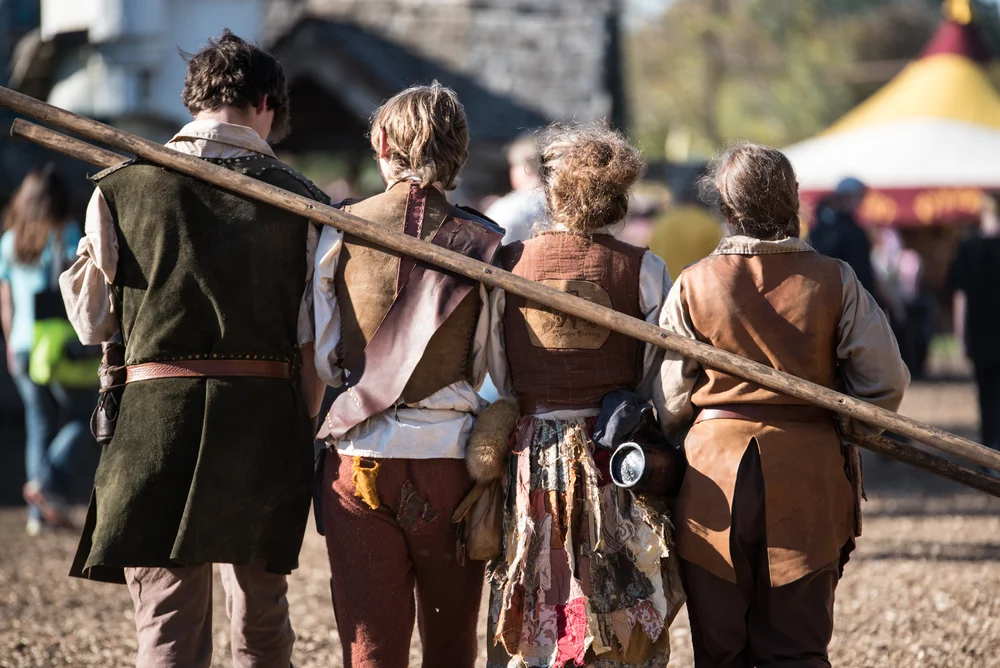
Movement as Voice: How Our Classes Teach Storytelling Through Movement
Northland Words is a 501(c)(3) nonprofit arts organisation based in Rochester, Minnesota, and our remit is broad: theatre, literature and music, stitched together through productions, classes, festivals and community gatherings. We work with children in school holiday programmes, with adults who sign up for a class after a long day of paid work, with families who arrive early at a festival to secure a good patch of grass, and with students who are preparing for auditions they have not quite prepared for.
The question we keep returning to, in staff meetings and in the studio, is how our classes teach storytelling through movement. The short answer is that the body does the talking. Words carry the plot; weight, rhythm, stillness and distance carry the meaning. So we asked our teaching artists to describe a typical session, and what came back was warm-ups, walking exercises, invented tableaux, improvised weather and the occasional controlled fall onto a mat.
Why the Body Does the Talking
Experienced actors often say the line is the last thing to arrive. Before a character speaks, the audience has already read something: the set of the shoulders, the speed of the crossing, the way a hand refuses to touch the object it wants. Our classes lean into that first read. Rather than asking a student to interpret a paragraph and then hunt for a gesture to hang on it, we ask them to build the physical life of the scene first, and let the words settle onto that structure.
In a beginner session, twenty minutes go to a walking exercise that looks like nothing at all. Students cross the room in six different ways: late for a train, late for a train and pretending otherwise, running from something, walking with a great deal of luggage, walking as though the floor might be lava, and walking with nothing at all to do. Nobody performs at full volume. The difference between the third version and the sixth is a small shift in the ribcage, and it is legible from the back of the room. By the time we introduce a monologue, students already have a vocabulary for intention, resistance and fatigue.
That vocabulary travels well beyond the stage. Physical training sharpens spatial awareness, ensemble listening and the willingness to commit to a decision without hedging it. It gives adults a way back into their own bodies after years of sitting still in chairs, and it gives young performers a technique that is invisible to an audition panel but obvious in a rehearsal room. The techniques are borrowed honestly from mime, from mask work, from stage combat training and from the nineteenth-century art of the tableau, where a frozen arrangement of bodies can carry a whole narrative without a word.
Inside a Ninety-Minute Session
Our adult sessions follow a shape that students recognise quickly. Ten minutes of warm-up, fifteen on a movement score, twenty with the text, twenty-five on improvisation and the sharing of scenes, and the final fifteen for feedback. The order matters more than it might look. Warm-up is not filler; it is where a student learns the rules of the room, who moves when, and what it feels like to be watched while thinking.
Several strands run at once. A beginners class called Movement and Monologue works with plain text and physical scores. A youth class, Story in Motion, uses folktales and short fiction, so that eleven-year-olds can spend a term turning a story into a sequence of images before they worry about delivering a line. Family sessions work with trickster figures and old tales, which suits mixed-age groups because the youngest members often supply the most honest physical choices in the room.
Above the classes sits our community ensemble, which rehearses in the same building and performs publicly each summer. You can read more about the company and its season About Words Players Theatre, including how the ensemble is recruited, what the rehearsal calendar looks like, and why we insist on movement work before the first table read.
Text, Verse and the Rehearsal Room
Watch a class stage a scene and you will notice how rarely the dialogue arrives on time. Students hold a moment of silence longer than seems comfortable, walk to a door that is not there, and let a sentence sit in the air while somebody else finishes an action. This is the heart of how our classes teach storytelling through movement: the scene acquires a rhythm first, and the rhythm then governs the pacing of the speech.
For Shakespeare, that logic is even stronger. Verse asks the body to keep time, because the metre has to be carried somewhere in the body or it falls flat. We build a scene as a series of physical scores — a sequence of crossings, a lift, a fall, a change of level — and only then hand out the lines. Students discover that an angry speech wants speed and a grieving one wants weight, and that the difference is easier to find in the shoulders than in the head.
Our summer Shakespeare in the Park series is where this training meets a public audience. The productions are staged outdoors on a grass stage, so the ground itself becomes a prop, and actors have to project without a roof to hold the sound. If you are planning to visit or want to know how the series runs, our Rochester festival tips cover seating, the evening schedule, the weather policy and the best patches of lawn. The Thornton Wilder Short Play Festival follows in the same season, with local writers producing short pieces, and the brevity of those works forces exactly the kind of physical economy our classes teach.
Taking This Work to Australian Stages
Australian readers will notice the calendar before anything else, and it is inverted. Our open-air season runs in June and July because Minnesota summers are hot and humid; an outdoor Shakespeare season in Australia is more likely to sit in December or February, with the heat, the flies and the sunscreen that comes with them. Under a sky like ours, actors can afford to be still. Under a Melbourne sky in January, the same stillness reads as courage.
Language conventions travel too. Australians write theatre, programme and organisation, and we have matched those spellings in our teaching materials so scripts and study guides read naturally in Australian hands. Australian practice also places the full stop inside the quotation marks, and we have adopted it for our printed scripts, which changed something subtle in how a line sounds when it is read aloud. Small conventions, but they are the difference between material that travels and material that needs translating.
The wider market is worth thinking about as well. Australian theatre has a well-established ecology of community companies, state and council grants, and a job title — theatre maker — that has no exact equivalent in the United States. Touring costs and regional audiences shape the work in ways that reward a physical vocabulary, because an image needs no translation and travels in a van. Our own closest neighbour in spirit is Quest Visual Theatre, whose devised and visual work shows how a story can be told with bodies, light and objects rather than dialogue, and whose approach to ensemble creation has shaped how we design our summer courses.
Look around the country and you find the same appetite we see in Rochester: the small open stage in Melbourne's Little Lon, the river amphitheatres of Brisbane and Sydney, the dozens of companies performing at the Adelaide Fringe every year. Community theatre there runs on raffles, on comp tickets, on folding chairs carried in the back of a car, and on audiences who arrive early because the arvo light is better before the sun drops.
Youth, Families and the Neighbourhood
Programs for young people shape the community around them, and our school holiday weeks are loudest. In January, Minnesota children are skating on frozen ponds while our studios fill with noise and movement; Australian families reading this will have the opposite problem, so we publish our winter indoor schedule early for anyone hoping to run something similar in their own holiday programme.
Intergenerational work matters just as much. Our story circles bring grandparents, parents and children into the same room around a table of photographs and local folklore, and the physical work follows naturally from the material: somebody demonstrates how a character walked, somebody else reinvents the ending. Several of the pieces performed at our short play festival began in those circles, which keeps the festival rooted in the neighbourhood rather than in a taste imported from elsewhere.
The outcomes are easy to chart in less measurable ways. A teenager who froze in an audition last year now leads a scene. An adult who said she had no creative outlet now directs a family piece. A retired teacher volunteers at the festival gate and stays to read every short play we stage. That is the whole argument for teaching storytelling through movement: it is not decoration on top of the work, and it is not a warm-up to be skipped. It is the work.
Step Into the Circle With Us
Classes, festivals and gatherings are open to anyone, and the only requirement is a willingness to move badly for a while. Registration runs term by term, and our festival programme is announced in the spring, with volunteer call sheets going out weeks ahead of the first performance. If you would like to join a class, ticket a summer play, lend a hand at the gate, or support a 501(c)(3) that keeps community arts affordable in Rochester, the contact details and the season calendar are on our site. And if you are sitting in Melbourne, Sydney, Adelaide, Perth, Brisbane, Canberra or Hobart with an idea for a movement-led storytelling programme of your own, write to us. We trade methods, our teaching notes and, occasionally, our short plays with anyone who thinks the body is a good place to start a story.